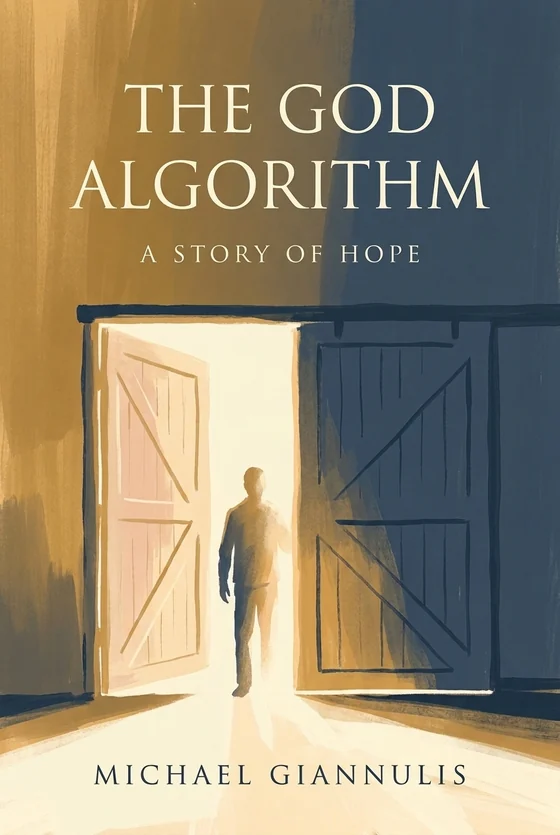
A novel by Michael Giannulis
The God Algorithm
A Story of Hope
A novel about doubt, honest argument, and the people who show up anyway.
Printing now
The first edition is printing now. Store links will appear on this page as soon as the book is on sale.
The story
Every Saturday, one new rule
Sam Lewis tests software for a living. On the side, he stands up in front of strangers and argues that God doesn't exist.
Then a retired engineer named Daniel invites him to a barn at the end of a gravel road, where an old machine can build a whole world, and makes him a dare: every Saturday, change one rule and show how God should have done it.
A world where no one can doubt. A world where no one gets hurt. A world where everyone is forgiven for free. Every Saturday the world breaks, and it breaks because of the rule Sam typed.
Meanwhile his sister, Kate, is asking him for one afternoon in August: to stand beside her in a church hall while she says out loud what their family never has.
A novel about doubt, honest argument, and the people who show up anyway.
The Saturday worlds
Real questions, argued fairly
Each Saturday tests one rule Sam thinks God got wrong. Every argument in the book stands on real philosophical work, from Augustine and Pascal to the philosophers still arguing today. Here are the questions. How each world breaks is the book's to tell.
A world where no one can doubt
If God exists and wants a relationship with us, why isn't his existence obvious to everyone?
The arguments on both sidesA world where no one can refuse
Could God have made free people who always choose the good? If he could, why didn't he?
The arguments on both sidesA world where no one has to ask
If God already knows what we need and is good, why ask at all? And why do so many prayers seem to go unanswered?
The arguments on both sidesA world where no one gets hurt
Why would a good God make a world where bodies break, and where nature hurts people nobody can blame?
The arguments on both sidesA world where everyone is forgiven for free
Why can't God simply forgive? What is the cross for, and is it fair for an innocent person to pay for the guilty?
The arguments on both sidesA world where the dead stay
Is the Christian hope of resurrection a comfort people invented, or is there a real case for it?
The arguments on both sidesA world where no one is sent away
Could a good God let anyone be lost forever? Or would forcing everyone into heaven be its own kind of cruelty?
The arguments on both sidesA world where everyone gets the same start
Where and when you are born shapes almost everything, even whether you ever hear about God. How can that be fair?
The arguments on both sidesA world where no animal suffers
Free will cannot explain the pain of animals that lived and died long before any human. Why would a good God allow it?
The arguments on both sidesBefore you begin
A note from the author
I wrote this book to be fair. It takes on the arguments I believe most often move people toward belief in God, or away from it, and it tries to give each side its strongest case.
It is a novel first, and I hope you read it as a story. But nothing in it is there by accident. Every argument in these pages stands on real philosophical work, and the people in it argue the way thoughtful people actually do.
Read it, argue with it, and make up your own mind. If it starts a conversation, I would love to hear about it at godalgorithmbook.com.
Michael Giannulis
For book clubs
A discussion guide, free
Questions for each part of the book, with spoilers clearly marked, plus the real debates behind each Saturday. Print it or bring it up on your phone.
Open the guideA note on content
What to know before reading
This story deals with a pastor's abuse of two children, and with a church that kept it quiet. It is never described in detail.
There is no romance, violence stays off the page, and the language is mild.
Questions
Frequently asked
What is The God Algorithm about?
Sam Lewis tests software for a living and, on the side, argues in public that God doesn't exist. A retired engineer named Daniel invites him to a barn where an old machine can build a whole world, and dares him: every Saturday, change one rule and show how God should have done it. Meanwhile Sam's sister, Kate, is asking him to stand beside her in a church hall in August while she says out loud what their family never has.
Who wrote it?
Michael Giannulis is a PhD candidate in Bible Exposition at Liberty University's Rawlings School of Divinity, where he also studies Christian apologetics. The God Algorithm is his first novel.
Is it a Christian novel? Will skeptics find it fair?
It sits on the Christian and inspirational fiction shelf, and it was written to be fair to both sides. The author's note says it takes on the arguments that most often move people toward belief in God or away from it, and tries to give each side its strongest case. The skeptic in the story makes the real skeptical case, and the believers make the best case they can without preaching.
Do I need to know philosophy to enjoy it?
No. It is a novel first. Sam explains things the way you would explain them to a friend. If you want to go deeper, the arguments page on this site lists the real thinkers and books behind each Saturday world.
Does the book contain difficult content?
Yes, and the book says so up front: "This story deals with a pastor's abuse of two children, and with a church that kept it quiet. It is never described in detail." There is no romance, violence stays off the page, and the language is mild.
When can I buy it?
The first edition is printing now. Store links will appear on this page as soon as the book is on sale.
Is it a good choice for a book club?
Yes. Each Saturday world raises a question people have argued about for centuries, which makes for long conversations. There is a free discussion guide on this site with questions for each part of the book, with spoilers clearly marked.
How can I get in touch with the author?
Use the Write to Mike form on this site. Messages go straight to Michael Giannulis. He would love to hear what the book started for you.